.............................................................................................................................................................................
Showing posts with label the blues. Show all posts

TRAVELLING IN THE NORTH COUNTRIES, AND A SOUTHBOUND TRAIN

This is a look back over my October-November tour of talks, now that I'm home again in the southwest of France.

I gave talks on BOB DYLAN & THE HISTORY OF ROCK'N'ROLL at Cape Breton University, Nova Scotia, Canada; at the University of Texas at Austin; at Arkansas State University at Jonesboro AR; and at the University of Oslo. And I gave talks on BOB DYLAN & THE POETRY OF THE BLUES at Dalhousie University, Nova Scotia, Canada; at the University of Chicago; at Southwestern University, Georgetown TX; at Nebraska Wesleyan University in Lincoln NE; at the University of Nebraska at Kearney; and at Goldsmiths College, London.
The quirky, surprisingly classy-roomed Royal Hotel, Cape Breton, Nova Scotia

Aside from the talks themselves, and the people who made up my audiences and hosts, and others met along the way, the most memorable episodes for me were encountering US Customs & Immigration on the way in  to Chicago from Canada, and the 29-hour train ride I took out  of Chicago all the way down south to Austin Texas.

I'd expected to meet US Customs & Immigration when I reached  Chicago, but no, they occupy a whole portion of the main airport in Montreal - and a vast acreage of corridors and checkpoints it is too. And instead of granting me the Visa Waiver Business stamp for my passport straight away, as always in the past, they made me wait, and then pulled me aside - "Is there a problem?" "No, no problem: just go and take a seat over there, sir, please"... and so I had to sit and fret in a special waiting area while a gathering of these officers discussed me. None seemed able to dare be responsible for simply letting me in. Time passed. Then one of them, who looked more like a lapsed Amish in fancy dress than an immigration officer, called me over to his small cubicle ("Michael, just step in here a moment...") and grilled me for the longest time, making me show him all the university letters of invitation I had with me, peering through my 7-page printed itinerary like a man who could hardly read, and then sending me back to the forlorn and deserted waiting area while he went off once more to consult . . . while I sweated away and the time ticked by right up to my the gate-closing time for my flight - and beyond. Then he called me back int one more time (and it was "Mr Gray" now, which sounded worse) - and finally gave me the passport stamp thtree minutes before my flight was leaving from a long way away down the airport. "There are plenty of flights to Chicago," he smirked. Mine, of course, was of the cheap, non-transferable type, valid for that flight only. Luckily, Air Canada were kind and gave me a boarding pass for the flight a couple of hours later. Not my favourite part of the trip.

But ah, Chicago. The parts of the university I saw - the music department lecture theatre and the quadrangle you reach it from -  are elegant Victoriana, with ivy climbing stone walls and mullioned gothic windows: all this in sharp contrast to the soaring drama of the city's skyscrapers, which cluster together gleam with far more panache than New York's. I didn't have enough time here, really, to enjoy the zing of the city, before I set off in a cab to Union Station.

The train was just great. 29 hours with no wifi available (and in my case no American mobile phone): 29 hours throughout which no-one could demand anything from me. So rare a thing today. Just the innate glamour of the epic ride, the dining-car sociability - they put you together with strangers at shared tables - the changing landscape, the sleeping compartment, and the sheer olde worlde physicality of it: all iron and steel and rattling tracks and big old bridges taking you high up over muddy rivers and through woods with little wooden houses and mules and rusting 1940s pick-up trucks. We'd pulled out of Chicago at 1.45pm, and rolled on through the afternoon and evening, and all through the night. When I woke in the early morning we were crossing into Texas, and it took all that second day to clatter down through that enormous state; and after I disembarked at Austin, at 6.35pm, it was going to go head on further south, still in Texas, for a number of hours more.


And then at the end of my trip, the flight back to France from Montreal, and a quick side trip to London for an especially enjoyable talk at Goldsmiths College in New Cross (where I used to live, not especially happily, once upon a time) and on to Oslo on Norwegian Air, which had wi-fi on the flight (!).
flying out of Montreal, November 1st
flying in towards Paris next morning

My first visit to Norway, and an unexpected pleasure from first to last - from the elegant airport with its beautiful wood-floored corridors and the highly congenial, efficient train into the good-looking city centre to the university and my reception there. Texas is well over twice the size of Norway, but a good deal less civilised.

Back again via London, and home to beautiful weather: days of 25+ degrees Celsius (77+ Fahrenheit), and the keen anticipation of receiving Bob Dylan's most essential Bootleg Series issue, The Cutting Edge. Altogether this trip I was away for 26 days.

I calculated my mileage totals this morning:

By road: 891
By rail: 1,780
By air: 15,829

TOTAL = 18,500 miles.

________________


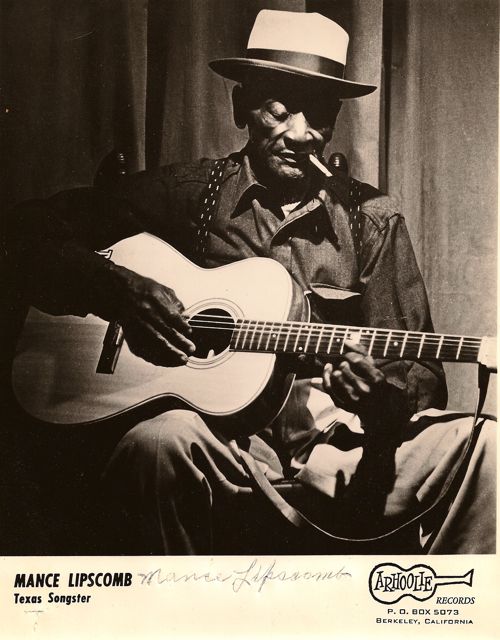
MANCE LIPSCOMB - SONGSTER BORN 120 YEARS AGO TODAY


He may be a minor figure in the story of the blues, but he's an interesting one, and one the very young Bob Dylan met, and their repertoires connect in several ways.

Here's my entry on him in  The Bob Dylan Encyclopedia:

Lipscomb, Mance [1895 - 1976]
In his 1965 book Conversation With the Blues, Paul Oliver makes the point that ‘if the blues, like any folk art or indeed almost any art form, is illuminating in terms of a whole group it is still sung and played by individuals...  the individual tends to become submerged...  and even when the assessment of the major figures is made, the minor blues singer is forgotten.’
To listen to much of Dylan’s work  -  which at least between his break with ‘protest’ and his conversion to Christianity in every sense put a consistent emphasis on the importance of the individual rather than the mass  -  is to feel that Dylan has not forgotten the minor blues singer at all. He has listened to the minor figures wherever the somewhat random process of recording folk artists has allowed. We know it from listening to his work.
(Where Dylan heard what; the influence of ‘minor figures’ and unknown ones; the communal nature of much blues composition and how this gells with post-structuralist ideas of the unfixed text and the death of the author: all these are big questions, much discussed throughout this book. They are also central preoccupations of Michael Gray’s Song & Dance Man III: The Art of Bob Dylan, Chapter 9, ‘Even Post-Structuralists Oughta Have The Pre-War Blues’.)
Dylan learnt and assimilated experience from the older songs and the older singers  -  singers who, in some cases, were ‘discovered’ or ‘re-discovered’ in the 1960s. Mississippi John Hurt is one example, the stylish and dapper Mance Lipscomb another.
Lipscomb was born 9 April, 1895, in Navasota, Texas  -  and eventually died there (on 30 January, 1976). He was ‘discovered’ in July 1960 by Mack McCormick and Chris Strachwitz and recorded  -  for the first time  -  a few weeks later in his two-room cabin, by which time he was in his sixties, though still with a strikingly youthful way of moving around in performance. He had almost a thousand songs he could perform.
Dylan met Lipscomb, and we can get an idea of the aura of the man, and thus a hint of the insights he could have given Dylan, from the description of him, and a transcribed conversational fragment, in Paul Oliver’s book. He was a ‘Texas sharecropper and songster with a reputation that extends widely in Grimes, Washington and Brazos counties...  A man of great dignity and natural culture...  a veritable storehouse of blues, ballads and songs of more than half a century... ’
This is Lipscomb talking (the spelling is as in Oliver’s transcript):
‘I been playin’ the git-tar now ’bout forty-nine years, and then I started out by myself, just heard it and learned it. Ear music...  My pa was a fiddler; he was an old perfessional fiddler. All my people can play some kind of music. Well, my daddy...  he played way back in olden days. You know, he played at breakdowns, waltzes, shottishes and all like that and music just come from me...  Papa were playing for dances out, for white folks and coloured. He played Missouri Waltz, Casey Jones, just anything you name he played it like I’m playin’ . He was just a self player until I was big enough to play behind him, then we played together...  ‘Sugar Babe’ was the first piece I learned, when I was a li’l boy about thirteen years old. Reason I know this so good, I got a whippin’ about it. Come out of the cotton-patch to get some water and I was up at the house playin’ the git-tar and my mother came in; whopped me n’cause I didn’t come back  -  I was playin’ the git-tar: “Sugar babe I’m tired of you, / Ain’t your honey but the way you do, / Sugar babe, it’s all over now...”’
            In Glen Alyn’s I Say Me For A Parable: The Oral Autobiography Of Mance Lipscomb, 1993, Lipscomb talks of encountering Dylan (and of Rambling Jack Elliott first hearing of Lipscomb when Dylan played him a Lipscomb record) but specifies no dates. Lipscomb says Dylan followed him to ‘Berkeley University’ and then ‘from Berkeley to the UCLA… And when I went off a duty he was settin round me, an hear what I was sayin, an pick up a lot of songs. He could imitate. But he wadna playin no gittah. Then. Takin you know, learnin from his head.’ On 18 May 1963, Dylan appeared on the same bill as Lipscomb at the first Monterey Folk Festival.
Lipscomb must have been an invaluable contact for Dylan  -  the one a black Texan with a personal repertoire stretching back to 1908 and incorporating songs a generation or two older than that, the other a white Minnesotan would-be artist of the whole American people born in 1941. Not only could Dylan have gained a knowledge ready to work for him but also, in a specific and personalised testimony, a feeling for the intimacy of connection of words and music in the expression of a spirit and a theme.
            Lipscomb’s repertoire included ‘Jack O’Diamonds Is A Hard Card To Play’ (he was field-recorded performing it in his home-town area the first time he ever recorded), which is a title-phrase picked up wholesale and retailed by Bob Dylan inside a piece of his own work that is not a blues. It is, in fact, from one of those poems he calls Some Other Kinds Of Songs . . ., published on the back sleeve of the album Another Side Of Bob Dylan. This long and generally inferior poem repeats several times, and then ends with,  ‘jack o’ diamonds / is a hard card t’ play.’
            Other songs Lipscomb recorded include ‘Baby Please Don’t Go’, ‘You Gonna Quit Me’ (the Blind Blake song on Dylan’s Good As I Been To You, re-titled ‘You Ain’t Gonna Quit Me’ by Lipscomb), ‘Corrina Corrina’, ‘Mama, Let Me Lay It On You’, a song called ‘When Death Comes Creeping In Your Room’ - a title that strongly suggests it may prefigure Dylan’s ‘Watcha Gonna Do’  -  and ‘Night Time Is The Right Time’. In the section called ‘Playing For The White Folks’ in the Glen Alyn book, Lipscomb claims that Dylan took ‘Baby Let Me Follow You Down’ from ‘his’ ‘Mama, Let Me Lay It On You’.

 [Mance Lipscomb: ‘Jack O’ Diamonds Is A Hard Card To Play’, Navasota TX, summer 1960; Mance Lipscomb Texas Sharecropper & Songster, Arhoolie LP 1001, El Cerrito, CA, 1960. ‘Night Time Is The Right Time’, nia.; Mance Lipscomb Vol. 4, Arhoolie LP 1033, El Cerrito CA, nia.]

MY OWN TOUR OF TALKS IN THE UK, NOVEMBER


MONDAY NOVEMBER 4: GRANTHAM, LINCS
audio-visually illustrated talk:
Bob Dylan & the History of Rock'n'Roll
Guildhall Arts Centre
St. Peters Hill, Grantham NG31 6PZ
7.30pm; tickets £10, concessions £8 buy tickets, and more info here

WEDNESDAY NOVEMBER 6: NEWPORT, S. WALES
audio-visually illustrated talk:
Bob Dylan & the History of Rock'n'Roll
Studio Theatre
The Riverfront Theatre & Arts Centre
Bristol Packet Wharf, Newport NP20 1HG
7.45pm; tickets £11; buy tickets, and more info here

FRIDAY NOVEMBER 8: BLANDFORD FORUM
audio-visually illustrated talk:
Bob Dylan & the Poetry of the Blues
Bryanston School, Blandford Forum, Dorset
7.30pm; private gig; David Jones Lecture Theatre

SATURDAY NOVEMBER 9: DORCHESTER
audio-visually illustrated talk:
Bob Dylan & the History of Rock'n'Roll
Dorchester Arts Centre
School Lane, The Grove
Dorchester DT1 1XR
8pm; tickets £10, concessions £8; buy tickets, and more info here

SUNDAY NOVEMBER 10: EXETER
audio-visually illustrated talk:
Bob Dylan & the History of Rock'n'Roll
Exeter Phoenix Voodoo Lounge
Bradninch Place, Gandy Street
Exeter EX4 3LS
8pm; £10, concessions £8; buy tickets, and more info here

TUESDAY NOVEMBER 12: HALESWORTH, SUFFOLK
audio-visually illustrated talk:
Bob Dylan & the History of Rock'n'Roll
The Cut, New Cut, Halesworth, Suffolk IP19 8BY
Box Office 0845 673 2123
7.30pm; tickets £10; buy tickets, and more info here

THURSDAY NOVEMBER 14: LEAMINGTON SPA
audio-visually illustrated talk:
Bob Dylan & the Poetry of the Blues
LAMP [Leamington Live Art & Music Project]
Riverside, Adelaide Rd, Royal Leamington Spa CV32 5AH
8pm; tickets £10; buy tickets, and more info here

SATURDAY NOVEMBER 16: BELFAST
audio-visually illustrated talk:
Bob Dylan & the History of Rock'n'Roll
Crescent Arts Centre
2-4 University Road, Belfast BT7 1NH
8pm; £10, concessions £8; buy tickets, and more info here

WEDNESDAY NOVEMBER 20: BURY, LANCS
audio-visually illustrated talk:
Bob Dylan & the History of Rock'n'Roll
The Met, Market St., Bury BL9 0BW
8pm; £10; buy tickets, and more info here

THURSDAY NOVEMBER 21: HELMSLEY, ENGLAND
audio-visually illustrated talk:
Bob Dylan & the Poetry of the Blues
Helmsley Arts Centre
The Old Meeting House, Meeting House Court
Helmsley, North Yorkshire YO62 5DW
7.30pm; £9, concessions £8; buy tickets, and more info here

BIG JOE WILLIAMS

superb photograph: apologies for not knowing who to credit


Big Joe Williams was born 110 years ago today. Here's his entry in my Bob Dylan Encyclopedia:

Williams, Big Joe [1903 - 1982]
Big Joe Williams, not to be confused with Joe Williams, singer with the Count Basie Band in the 1950s, was born in Crawford, Mississippi, on October 16, 1903 but began traveling beyond Mississippi in his youth, playing guitar and singing in lumber camps, and settled to an unsettled life  -  the classic roaming blues musician. He first recorded in 1935, gaining what was, in the Depression, an unusual 10-year contract with Bluebird.
            Linda Dahl, author of Stormy Weather, 1984, a book of profiles of women (mostly jazz) singers, claims that Mary Williams Johnson, not husband Big Joe, wrote his classic ‘Baby Please Don’t Go’, but Dahl’s source is almost certainly careless assumption from the sleevenotes of a series of LPs on the Rosetta label, which were, like Dahl, trying to raise the profile of women’s contributions to music. This admirable aim is not served by dodgy assertions. (At another point the same Mary Williams was the wife of Lonnie Johnson. No claim seems to have been made for her as the composer of his material.)
            In any case, ‘Baby Please Don’t Go’ is strongly based on the older common-stock number known as ‘Don’t You Leave Me Here’, which was at least 30 years old by the time Big Joe recorded ‘Baby Please Don’t Go’. It was recorded in its traditional form by Papa Harvey Hull & Long Cleve Rede, as by Sunny Boy And His Pals, in Chicago, on about April 8, 1927 (the same session that yielded the wonderful ‘Hey! Lawdy Mama - The France Blues’, which became one of the treasures of the blues revival era, covered, for instance, by Mark Spoelstra on that compilation album The Blues Project in 1964.)
            Either way, ‘Baby Please Don’t Go’ was a big hit for Williams, and he had a lesser success with a 1941 version of ‘Crawlin’ King Snake’. Well-known for his unique 9-string guitar and his erratic delivery, he performed with many of the greats of his day and, unlike so many, continued as a working musician all the way through till the blues revival movement occurred. He didn’t need to be ‘rediscovered’: he was already around.
            When Dylan paid his return visit to Minnesota in December 1961, and was recorded in a Minneapolis apartment, one of his best song-performances was of ‘Baby Please Don’t Go.’ (Dylan has rarely performed this song since those early days; its most recent rendition was when Dylan came onstage and performed it during the encore of a Tom Petty set in Holmdel, New Jersey on August 10, 2003.)
            At some point, Dylan sought Williams out and played with him. According to Blues Revue magazine, the Chicago-based Delmark Records founder Bob Koester (pronounced Chester) got Williams booked into Gerde’s Folk City in Fall 1961, and over a two-week period Dylan sat in with him: and before the end of the run, they were being billed as Big Bill and Little Joe. But according to Robert Shelton’s Dylan biography No Direction Home, 1986, it was in early 1962 that Mike Porco was considering booking Williams, and Dylan pressed him on it, saying ‘He’s the greatest old bluesman. You gotta put him in here.’ Shelton says that he was given a three-week booking that February and that Dylan showed up each night and jammed with him onstage several times. This would seem the more likely version, especially since the album Big Joe Williams at Folk City was recorded there on February 26, according to its own sleevenotes.
            (Extra confusion is added by the Koester camp by his claim that Dylan first showed up at a Big Joe gig in Chicago back in 1957 and befriended him then; Williams makes it worse by claiming that he first met Dylan in the 1940s, when ‘he was very very young, probably no more than six.’ Dylan himself compounds the confusion by writing, as an aside in Chronicles  -  and it is the book’s only mention of Williams  -  that ‘I’d played with Big Joe Williams when I was just a kid.’)
            At any rate, soon after the Gerde’s Folk City booking, in March 1962, Big Joe was in Brooklyn recording for Victoria Spivey’s small label Spivey Records when Dylan asked her if she could use a little white boy on one of her records. She put him back with the almost 60 year old Williams (not an easy man to play with), and the result was a tremendous version of ‘Sittin’ On Top Of The World’ on which Dylan, aged 20, plays very convincing blues harmonica and is also allowed to sing back-up vocals on the title line  -  and indeed more than back-up, since twice in the course of the performance Big Joe is generous enough to keep silent and let Dylan sing the line alone.
            Since Williams was trying to sound still in his prime, and Dylan was trying to sound as ancient as the hills, it’s a comical moot point here as to who sounds the older of the two. Dylan also plays harp behind Williams on a less striking ‘Wichita’, and on a formless jam later titled ‘Big Joe, Dylan and Victoria’ and behind Spivey’s vocals and piano on ‘It’s Dangerous’.
            In 1980 Mike Bloomfield published a short memoir, Me and Big Joe, which not only portrayed the difficulties of their relationship very honestly but also, in Peter Narváez’ phrase, illustrated ‘the cross-cultural triumph of the blues tradition’. Bloomfield wrote: ‘Joe’s world wasn’t my world, but his music was. It was my life; it would be my life. So playing on was all I could do, and I did it the best that I was able. And the music I played, I knew where it came from; and there was not any way I’d forget.’
            As it turned out, Mike Bloomfield died before his mentor, in February 1981. Big Joe Williams died in Macon, Georgia on December 17, 1982.

[Big Joe Williams: ‘Baby Please Don’t Go’, Chicago, 31 Oct 1935; Big Joe Williams: ‘Crawlin’ King Snake’, Chicago 27 Mar 1941, 1st vinyl-issued Big Joe Williams: Crawlin’ King Snake, RCA International INT-1087, London, 1970; Big Joe Williams at Folk City, 26 Feb 1962, Bluesville BVLP 1067, US, 1962. Papa Harvey Hull & Long Cleve Rede, c.8 Apr 1927, 1st vinyl-issued Really! The Country Blues, Origin Jazz Library OJL-2, NY, c.1961. Sunny Boy And His Pals: ‘Don’t You Leave Me Here’, Chicago, c.8 Apr 1927. Big Joe Williams & Bob Dylan: NYC, 2 Mar 1962, ‘Sittin’ On Top Of The World’ & ‘Wichita’, Three Kings & A Queen, Spivey LP 1004, NY, 1964; Big Joe Williams, Victoria Spivey & Bob Dylan, NYC, 2 Mar 1962, ‘Big Joe, Dylan & Victoria’ and Victoria Spivey & Bob Dylan, ditto, ‘It’s Dangerous’, Three Kings & A Queen Vol. 2, Spivey LP 1014, NY, 1972. Bob Dylan: ‘Baby Please Don’t Go’, Minneapolis, 22 Dec 1961.
            Bob Dylan Chronicles quote, p. 182. ‘Big Joe Williams: Memory of the Road’, Blues Revue, Mar-Apr 1995, no further details given, prĂ©cis seen online 5 Oct 2005 at www.expectingrain.com/dok/who/w/williamsbigjoe.html. Shelton ditto. Peter Narváez: ‘Living Blues Journal: The Paradoxical Aesthetics of the Blues Revival’, collected in Transforming Tradition: Folk Music Revivals Examined, ed. Neil V. Rosenberg, Urbana: University of Illinois Press, 1993. Mike Bloomfield, with S. Summerfield: Me and Big Joe, San Francisco: Re/Search Productions, 1980.]

MY U.S. TOUR OF TALKS!

The last college to have clinched, as it happens, is the first I'll be visiting, but here now, all confirmed, is the full list of my US tour dates, starting in 12 days' time:

MONDAY SEPTEMBER 23: BROOKDALE COLLEGE, LINCROFT NJ
audio-visually illustrated: Bob Dylan & the Poetry of the Blues
Brookdale Community College, 765 Newman Springs Rd, New Jersey 07738
7pm; Navesink Rooms 1 & 2; admission free

WEDNESDAY SEPTEMBER 25: CRESTVIEW HILLS, KENTUCKY
audio-visually illustrated talk: Bob Dylan & the Poetry of the Blues
Thomas More College, Crestview Hills, Kentucky 41017
7pm; Steigerwald Hall, Student Center

free admission; open to the public

THURSDAY SEPTEMBER 26: HANOVER, INDIANA
audio-visually illustrated: Bob Dylan & the Poetry of the Blues
Hanover College, Hanover IN
7pm; other details tba


TUESDAY OCTOBER 1: JONESBORO, ARKANSAS
audio-visually illustrated: Bob Dylan & the Poetry of the Blues
Arkansas State University, Jonesboro AR
7.30pm; Carl R. Reng Students Union Auditorium
free admission; open to the public

THURSDAY OCTOBER 3: SEARCY, ARKANSAS
audio-visually illustrated: Bob Dylan & the Poetry of the Blues
Harding University, Searcy AR
7pm; Cone Chapel

free admission; open to the public

MONDAY OCTOBER 7: NEW ORLEANS, LOUISIANA
audio-visually illustrated: Bob Dylan, McTell & the Blues
Tulane University, 6823 St Charles Ave, New Orleans, LA 70118
5pm; Dixon Recital Hall
; free admission; open to the public

TUESDAY OCTOBER 8: AMHERST, NEW YORK
audio-visually illustrated: Searching for Blind Willie McTell
Daemen College, 4380 Main Street, Amherst, NY

7.30pm; Alumni Lounge, Wick Center; free admission

BOB DYLAN & POETRY OF THE BLUES TOUR CONTINUES!

The remaining dates on my UK October 2012 tour (which began in Northern Ireland on October 4) are as follows:

TUESDAY OCTOBER 16
GUILDHALL THEATRE, DERBY
Guildhall Theatre
Market Place, Derby, DE1 3AH
Box Office 01332 255800 or online
Bob Dylan & the Poetry of the Blues

talk with loud music and rare footage
7.30pm;
£13.25, £11.25 (but cheaper online) on sale now

WEDNESDAY OCTOBER 17
THE MET, BURY
The Met, Market Street, Bury, Lancs BL9 0BW
Box Office 0161 761 2216 or online
Bob Dylan & the Poetry of the Blues
talk with loud music and rare footage
8pm; tickets £10 on sale now

THURSDAY OCTOBER 18
GALA, DURHAM
Gala Durham, 1 Millennium Place, Town Centre,
Durham DH1 1WA
Box Office 0191 332 4041
or online

 Bob Dylan & the Poetry of the Blues
talk with loud music and rare footage

7.45pm; tickets £15 on sale now

FRIDAY OCTOBER 19
QUEEN'S HALL, HEXHAM
Queen’s Hall Arts Centre, Beaumont Street
Hexham, Northumberland NE46 3LS
Box Office 01434 652477 or online here
Bob Dylan & the Poetry of the Blues
talk with loud music and rare footage

7.30pm; tickets £10; on sale now

MONDAY OCTOBER 22
UNIVERSITY OF YORK

The Berrick Saul Auditorium
Humanities Research Centre
University of York

Heslington, York YO10 5DD 
Bringing It All Back Home: York’s Pioneer of Dylan Studies
6.30pm; free public admission but by ticket;

ticket details here

WEDNESDAY OCTOBER 24
CANTERBURY FESTIVAL 2012
Canterbury Festival,
Canterbury Cathedral Lodge,
The Precincts, Canterbury, Kent CT1 2EH

Box Office 01227 787787
Bob Dylan & the Poetry of the Blues
talk with loud music and rare footage

5.30pm; tickets £8 on sale now

THURSDAY OCTOBER 25
ARLINGTON ARTS CENTRE, BERKS
Arlington Arts Centre, Mary Hare, Newbury RG14 3BQ
Box Office 01635 244246
OR ticketweb OR boxoffice@arlingtonarts.co.uk
Bob Dylan & the Poetry of the Blues
talk with loud music and rare footage

8pm; tickets £10 on sale now

FRIDAY OCTOBER 26
BEDWORTH ARTS CENTRE, nr. COVENTRY & NUNEATON
Bedworth Arts Centre, High Street, Bedworth
Warwickshire CV12 8NF
Box Office 024 7664 3255 www.ticketsource.co.uk/bedworthartscentre
Bob Dylan & the Poetry of the Blues
talk with loud music and rare footage
8pm; all tickets £10, on sale now


SUNDAY OCTOBER 28
TOTNES STUDIO LOUNGE, DEVON
Totnes FM Studio Lounge, Unit A, The Scope Complex
Wills Road, Totnes TQ9 5XN
Box Office: 01803 862 267 / buy online here

Bob Dylan & the Poetry of the Blues
talk with loud music and rare footage

8pm; tickets £8 in advance, £10 on the door; on sale now

MAP OF UPCOMING BOB DYLAN & POETRY OF THE BLUES DATES

Here's a map showing the locations of the October 2012 UK gigs of mine: BOB DYLAN & THE POETRY OF THE BLUES: An Evening With Michael Gray. Click on a blue marker to see the detailed info on where & when, ticket prices, box office numbers and whether it's on sale yet. For a list of these dates, see here. (I still hope further dates might be added before too long.)


View Bob Dylan & the Poetry of the Blues, Oct 2012 in a larger map

MY OCTOBER UK LIVE EVENTS