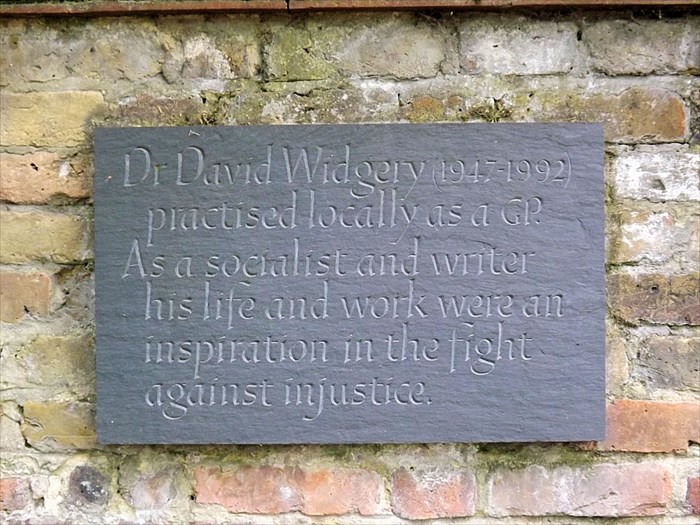
It's 20 years since the writer, socialist and East End of London doctor David Widgery died prematurely, and I want to join those who have written about him in recent days. I'm not sure I was a friend of his - perhaps we were only good acquaintances - but he occupied a unique place in my life between the 1960s and 1980s. Some personal memories...
The first time we met must have been in early 1965 in Sheffield, at an event organised by some short-lived organisation seeking to bring together (who knows why?) the editorial staff of student papers and magazines from “the new universities". I was the 19-year-old editor of the University of York's magazine; the even younger Widgery was a Royal Free Hospital Medical School student, a member of IS (International Socialists) and editor of a magazine called U. (He was splendidly non-U.) The first time he spoke to me, it went like this:
“What's your magazine's title?", the organiser asked me.
“Eboracum", I said.
“E-bore-acum more like", said Widgery loudly, arriving in the conversation with the kind of abrasive impatience he would alternate with warm and tender straightforwardness throughout his life.
By 1967 he was sharing a flat in Chapel Market, Islington (and there was nothing New Labour Bijou about that part of Islington then: it was a slum running parallel to Engels' White Lion Street and strewn with cabbages after market days) with two ex-students I knew from York. I was allowed to move in for a while, and got to know Dave much better. He played two LPs obsessively that summer, Miles Davis' Sketches Of Spain and Judy Collins' In My Life, while we all wrote freelance articles and awaited the revolution. My first piece, for Melody Maker, was a rock fan tirade against plastic pop; his, for New Statesman, a tirade against the “grown-up power" of all the politicians the magazine admired.
In 1968 he came up to York University to address a fractious student meeting on behalf of the newly-formed RSSF (Revolutionary Socialist Students' Federation), and back in London that year he and I were compadres in low-level street action against the state: he put up anti-Vietnam War posters and I drove him and the posters from site to opportunist site in my blue mini-van, the sides of which, in gold lettering of hippyish design, still bore the legend Pitville Circus, the name of my defunct though pioneering headshop in the north of England. We were stopped by the fuzz at the crossroads at Angel, posters confiscated, van scrutinised incompetently for roadworthiness deficiency (they tested the handbrake by trying to push the van backwards, not noticing that I had slipped it into first gear...) and both of us charged to appear before the magistrates' court. I think we were let off. Grown-up power, pah!
We continued to meet from time to time, usually in others' company. The photograph above, published here for the first time, I took in Soho in June 1973, along with shots of Sheila Rowbotham and Nigel Fountain. (If you don't know who they are, you'd benefit from finding out.) Dave and I spent an evening drinking with Robert Shelton at some point soon afterwards, with Dave at his most abrasive and impatient, with the other's slow delivery and apolitical Americanness (in other words, his Americanness), mellowing a little only as drink sank us all towards sentimentality.
In 1977, having moved across from editing OZ after Richard Neville and co. were put on trial, to editing Temporary Hoardings, the youth paper of Rock Against Racism, Dave got me to write its obituary of Elvis Presley. He appreciated that Elvis had drawn on black music because he'd loved it, even though by then he'd long been a figure held in the greatest possible contempt both by all Widgery's political friends and by the punks at whom Temporary Hoardings was aimed.
In 1980, when Bob Dylan was deep in his Born Again craziness and I was a year into working for Gerry Rafferty from an office in Tunbridge Wells, I moved to a flat there, on a street named Mount Ephraim. Dave lost no time in phoning me to scoff that my choosing a name like that signified an extreme devotion to where my hero's head was. We drifted out of anything beyond occasional contact after that (though certainly not because of it). He put his energy where his political mouth was - fighting for the poor by working hard for them as a GP.
I was shocked by his unreasonable death, though it was caused by an excessive drink and drugs session entirely in line with his short lifetime of unrestraint - and I'm a bit shocked now to realise that it happened twenty years ago.
To read him online (most handily here) is to get a vivid glimpse of the man behind his energetic, rousing prose, his political ardour and his frequent resultant wrong-headedness - see for instance his article ‘Lennonism': a rose-tinted tribute as soppy as Dylan's more recent one, though involving more thought and more work. At least as representative, though, are two passages on very different topics, chosen by David Hayes of openDemocracy here, showing the power, intelligence and sheer talent of Widgery's writing:
“To read Kerouac when you were 15, scrabbling through the Ks of Slough Public Library, was a coded message of discontent; the sudden realisation of an utter subversiveness and licence. He legitimised all the papery efforts of a child writer, dream books, pretend novellas, invented games, planned and described walkouts. He expressed a solution to the pent-upness, exitlessness of youth, that feeling of wanking off inside all the time. Everyone I know remembers where they were when they read On the Road, whether newly expelled from school, public librarians (trainee) in Hammersmith, car park attendants in Dorking, knowledgeable Eisenhower drunks or hospital porters, because of the sudden sense of infinite possibility. You could, just like that, get off out of it into infinite hitchhiking futures. Armed only with a duffle coat, you could be listening to wild jazz on the banks of the Tyne or travelling east-west, across the Pennines. Mostly we never actually went, or the beer wore off by Baldcock High Street and you were sober and so cold. But we were able to recognise each other by that fine, wild, windy prose and the running-away motif that made so much sense." (He was 22 when he wrote that.)
“My interest, affection, it’s hard not to call it love, for Sylvia Pankhurst has grown over the last five years spent practicing as a doctor not half a mile from her old home in the Old Ford Road. East London is different now, studded with tower blocks and fenced with corrugated iron. But curiously the same. Still solidly proletarian, still the sweatshops and street-fights and rent strikes and plenty of old lady patients who remember ‘our Sylvia’ with a twinkle. Still the migrants, speaking Bangla Deshi rather than Yiddish, still the dole queues, longer now than ever. And still a revolutionary socialist minority, of which I’m part, spouting at street corners, dishing out leaflets, spreading union membership, occupying hospitals due for closure. Sometimes I feel Sylvia’s presence so sharply, it’s like a political ghost leaning over my shoulder to look with anger and compassion at the wheezy infants and cooped up young mothers and panicky grannies who live in the council blocks the Labour Council has had the nerve to name after Shelley, Morris and Dickens." ("Sylvia Pankhurst, Pioneer of Working Class Feminism", Radical America, May-June 1979).
To read about Dave Widgery online is to see how widely he was valued by, and how strongly he contributed to, the British "far left", despite his range of admirable renegade tendencies. No-one who knew him could be surprised by the widespread affection and loyalty he won, and which was articulated as best people could when he died at just 45.
.............................................................................................................................................................................
Showing posts with label Gerry Rafferty. Show all posts
MY OCTOBER UK LIVE EVENTS
THURSDAY OCTOBER 4
ISLAND ARTS CENTRE, NORTHERN IRELAND
Island Arts Centre, The Island, Lisburn BT27 4RL
Box Office: 028 92 509509
Bob Dylan & the Poetry of the Blues
talk with loud music and rare footage
price tba; tickets go on sale early July
FRIDAY OCTOBER 5
DOWN ARTS CENTRE, NORTHERN IRELAND
Down Arts Centre, 2-6 Irish Street, Downpatrick,
Down BT30 6BP, UK
Box Office 028 4461 0747
Bob Dylan & the Poetry of the Blues
talk with loud music and rare footage
tickets £10, £8, on sale very soon
SATURDAY OCTOBER 6
CRESCENT ARTS CENTRE, BELFAST
Crescent Arts Centre, 2-4 University Road
Belfast BT7 1NH
Box Office 028 9024 2338
Bob Dylan & the Poetry of the Blues
talk with loud music and rare footage
start time, price & booking details to follow
FRIDAY OCTOBER 12
THE TOLBOOTH, SCOTLAND
The Tolbooth Arts Centre
Jail Wynd, Stirling FK8 1DE
Box Office 01786 274000
Bob Dylan & the Poetry of the Blues
talk with loud music and rare footage
8pm; tickets £10, £8 on sale now
SATURDAY OCTOBER 13
PAISLEY MUSEUM, SCOTLAND
60 High Street
Paisley PA1 2BA
0141 889 3151
Working with Gerry Rafferty
lunchtime talk
12.30pm; free admission
SATURDAY OCTOBER 13
PAISLEY ARTS CENTRE, SCOTLAND
New Street, Paisley PA1 1EZ
Box Office 0141 887 1010
Bob Dylan & the Poetry of the Blues
talk with loud music and rare footage
7.30pm; tickets £10, £6 will go on sale in August
TUESDAY OCTOBER 16
GUILDHALL THEATRE, DERBY
Guildhall Theatre
Market Place, Derby, DE1 3AH
Box Office 01332 255800 or online
Bob Dylan & the Poetry of the Blues
talk with loud music and rare footage
7.30pm; £13.25, £11.25 (but cheaper online) on sale now
WEDNESDAY OCTOBER 17
THE MET, BURY
The Met, Market Street, Bury, Lancs BL9 0BW
Box Office 0161 761 2216 or online
Bob Dylan & the Poetry of the Blues
talk with loud music and rare footage
8pm; tickets £10 on sale now
THURSDAY OCTOBER 18
GALA, DURHAM
Gala Durham, 1 Millennium Place,
Town Centre, Durham DH1 1WA
Box Office 0191 332 4041 or online
Bob Dylan & the Poetry of the Blues
talk with loud music and rare footage
7.45pm; tickets £15 on sale now
FRIDAY OCTOBER 19
QUEEN'S HALL, HEXHAM
Queen’s Hall Arts Centre, Beaumont Street
Hexham, Northumberland NE46 3LS
Box Office 01434 652477
Bob Dylan & the Poetry of the Blues
talk with loud music and rare footage
price & booking details to follow in July
MONDAY OCTOBER 22
UNIVERSITY OF YORK
The Berrick Saul Auditorium
Humanities Research Centre
University of York YO10 5DD
talk title tba
6.30pm; free public admission; reservation details tba
WEDNESDAY OCTOBER 24
CANTERBURY FESTIVAL 2012
Canterbury Festival, Festival House
8 Orange Street, Canterbury, Kent CT1 2JA
Box Office 01227 787787
Bob Dylan & the Poetry of the Blues
talk with loud music and rare footage
5.30pm; tickets £8, on sale July
THURSDAY OCTOBER 25
ARLINGTON ARTS CENTRE, BERKS
Arlington Arts Centre, Mary Hare, Newbury RG14 3BQ
Box Office 01635 244246 OR ticketweb OR boxoffice@arlingtonarts.co.uk
Bob Dylan & the Poetry of the Blues
talk with loud music and rare footage
8pm; tickets £10 on sale now
FRIDAY OCTOBER 26
BEDWORTH ARTS CENTRE, nr. COVENTRY & NUNEATON
Bedworth Arts Centre, High Street, Bedworth
Warwickshire CV12 8NF
Box Office 024 7664 3255 www.ticketsource.co.uk/bedworthartscentre
Bob Dylan & the Poetry of the Blues
talk with loud music and rare footage
8pm; tickets £10; booking details to follow
GERRY RAFFERTY'S 'BAKER STREET' REVISITED
BBC Radio 4's arts series Soul Music, which takes a significant song and explores its genesis and residual importance, will turn its attention to Gerry Rafferty's ‘Baker Street' on the last day of January 2012 (at 11.30am UK time). It was last January that Rafferty died, aged 63, from problems related to his alcoholism.
The programme has been made by independent producer Karen Gregor, who writes about it here for the BBC's Ariel magazine (which has now been abolished in print form). She interviewed me for the programme in Bristol back in November (and tells me I've made the final cut). I come into the story because after I'd come in, briefly, from the cold of freelance writing in the second half of the 1970s, I was head of press for the record label that released the record, and then moved across to become Gerry's personal manager I knew him well at close quarters over a period of around four years.
Notably the Soul Music programme has succeeded in getting an interview from Rafferty's daughter Martha, but has failed (I believe) to track down the sax player from the session, Raphael Ravenscroft, in spite of many attempts to make contact. Can the programme finally vanquish the idea that Ravenscroft created the riff that was so crucial to the record becoming such an international, long-lasting hit? The audible proof is there from the demos that Rafferty himself created the riff and placed it within the song's structure exactly where it ended up.
After Gerry's death I blogged a personal piece here and my more formal obituary was published in The Guardian. Unsurprisingly, it argues that 'Baker Street' is not the be-all and end-all of Gerry Rafferty's achievement:
Gerry Rafferty in Air Studios, Montserrat WI
photo © Michael Gray 2012
“The Scottish singer-songwriter Gerry Rafferty, who has died aged 63 after a long illness, wrote the multimillion-selling hit Baker Street, which more than 30 years after its 1978 release still netted him an annual £80,000. At the end of the 1970s he did his best work, a series of richly resonant albums that gave no hint of their creator's inner troubles.
Rafferty was born in Paisley, near Glasgow, an unwanted third son. His father, Joseph, was an Irish-born miner. His mother, Mary Skeffington, whose name would provide a Rafferty song title, dragged young Gerry round the streets on Saturday nights so that they would not be at home when his father came back drunk. They would wait outside, in all weathers, until he had fallen asleep, to avoid a beating. “If it wasn't for you, I'd leave," Mary told Gerry. Joseph died in 1963, when Gerry was 16.
That year, Gerry left St Mirin's academy and worked in a butcher's shop and at the tax office. At weekends, he and a schoolfriend, Joe Egan, played in a local group, the Mavericks. At a dancehall in 1965, Gerry met his future wife, apprentice hairdresser Carla Ventilla. She was 15, from an Italian Clydebank family. They married in 1970, after courting at the bohemian bungalow of the artist and future playwright John “Patrick" Byrne and his wife, Alice. Byrne, also educated at St Mirin's, had long been Gerry's mentor, and had first interested Gerry in playing the guitar. Billy Connolly was also in Clydebank, and after Gerry's song Benjamin Day failed as a Mavericks single, Gerry and Egan quit the group and Gerry joined Connolly's outfit, the Humblebums, a Clydeside folk act.
The Humblebums' first LP, on the folk-oriented label Transatlantic, predated Gerry's involvement, but he and Connolly were the group for the albums The New Humblebums (1969, with cover art by Byrne, a partnership that later spanned the albums of Gerry's heyday) and Open Up the Door (1970). Despite US releases, singles written by Gerry (Shoeshine Boy and Saturday Round About Sunday) and John Peel sessions for the BBC, there was little reaction and tensions grew between these strong personalities. It was Gerry who urged Connolly to go it alone as a comic. He went solo too. Staying with Transatlantic, his characteristically titled first album – Can I Have My Money Back? – began his real career in 1971, establishing him as a singer-songwriter, bringing folk fans with him and promoting his songs.
Yet in 1972, now with a young daughter, Martha, Gerry rejoined Egan to form Stealers Wheel, a soft-rock group. Their eponymous debut album climbed the US charts and included the million-selling Stuck in the Middle With You, memorably resurrected for a key scene in Quentin Tarantino's film Reservoir Dogs (1992). But their A&M record contract tied them to huge touring and album commitments, and imposed musicians upon them. Gerry quit.
He was persuaded back, and he and Egan became the sole group members, using backing musicians in the studio and on tours. A now-forgotten single, Everyone's Agreed That Everything Will Turn Out Fine, preceded the minor hit Star and the 1974 album Ferguslie Park. But Rafferty learned that their royalties had been filched, Egan returned to Scotland, and Stealers Wheel collapsed before the release of the album Right Or Wrong in 1975.
Disentangling Gerry from his contracts took three years, but his second solo career, beginning with City to City, was constructed more cannily. Demos for the album were made in Carla's parents' old house, on a four-track machine. Gerry played every instrument, including lentil-jar percussion. Signed to United Artists, he and Hugh Murphy co-produced the album for £18,000 in 1978. Fuelled by the smash hit single Baker Street, it sold 5 million copies and Gerry became a millionaire “overnight".
Refusing to tour America, he played a few British dates and recorded his successful follow-up, Night Owl (1979), which yielded further hits: Days Gone Down, Get It Right Next Time and the title track. These, plus the less popular Snakes and Ladders (1980, recorded in Montserrat), are the gorgeously produced works of Gerry's prime. The voice, redolent of both Lennon's and McCartney's, yet unmistakably his own; the music, a shimmering delta of sound; the songs, romantic yet pushily sardonic – all came to fruition thanks to Gerry's gift of perfect pitch and an obdurate determination to stick to his guns.
These were the years I worked for him. I was his personal manager – employee, not svengali – visiting the record company in LA, accompanying Gerry when he was working, and running the small office we set up for him in Tunbridge Wells, Kent. Sadly, my job was mostly to say “no" to people.
He did not want to have to out-platinum himself: he had money enough, and disliked being recognised. But behind an aggressive front, and a strong awareness of his own musical excellence, was fear. He turned down working with Eric Clapton, McCartney and others, telling Carla “nobody was good enough". In truth, he dared not sit down with superstars without a drink or five. So he sat at home – now 300 acres of Kent farmland and a Queen Anne house in Hampstead, north London – and convinced himself he could work alone with Murphy. Carla said later: “He was just stalling for time. Maybe some new project would suddenly happen, but I knew he'd crossed the line as far as the record business went."
His last successful foray was when, after contributing a vocal to the soundtrack of the film Local Hero (1983), he produced the Proclaimers' 1987 hit Letter from America. Gerry made two more albums that decade – Sleepwalking (1982) and North and South (1988). On a Wing and a Prayer followed in 1992, Over My Head in 1994 and Another World in 2000. They marked a decline in sales and standard.
He had always drunk too much, and now he spiralled into alcoholism, putting on weight, which made him unhappier. “He became dangerous at airports," said Carla, “and he'd scream across restaurant tables at me." In phases of renunciation, he smashed cases of superb wines into a stream on his land. Carla finally left in 1990: “There was no hope. I would never have left him if there'd been a glimmer of a chance of him recovering." She remained a source of dependable help, in contact until the end.
After their divorce, farm and Hampstead home gone, Gerry eventually moved to California, near to Martha, who worked for him. In 2008 Gerry left America, helped from wheelchair to plane by a woman he met in a video store. They rented a house in Ireland, until taxis and doctors refused to attend him. That August, a five-day binge at a five-star London hotel ended when the management had him admitted to hospital. He vanished in the night.
Splashed across the Sun, this story was otherwise ignored until 2009, when the Daily Mail resurrected it. Rafferty, urged to issue a statement, announced that he was “extremely well", living in Tuscany and preparing a new album. He was relatively well, but in Dorset, not Tuscany. He never made another album. For two decades, alcohol had dominated this creative and intelligent man's life."
Gerald Rafferty, born 16 April 1947; died 4 January 2011
Subscribe to:
Posts (Atom)

